


Calluses on feet – we take care of hard skin
Care for thickened skin on the feet
We work on calluses gently and without rushing, then show you how to slow their return between visits.
Callus care at our Mokotów practice
Calluses on feet are flat, hard patches of thickened skin. Skin builds them up to protect itself from constant pressure and friction. A callus shows where your foot carries too much load. At our practice we work on the callus and look for what is causing it.
Hard skin that burns when you walk
Yellowish, thick skin builds up under the ball of the foot, on the heels or on the toes. After a day on your feet it burns, and the foot feels “like stone”. The rough edges catch on tights. If the hard skin on your heel starts to split, see how we care for cracked heels.
We reduce thickened skin layer by layer
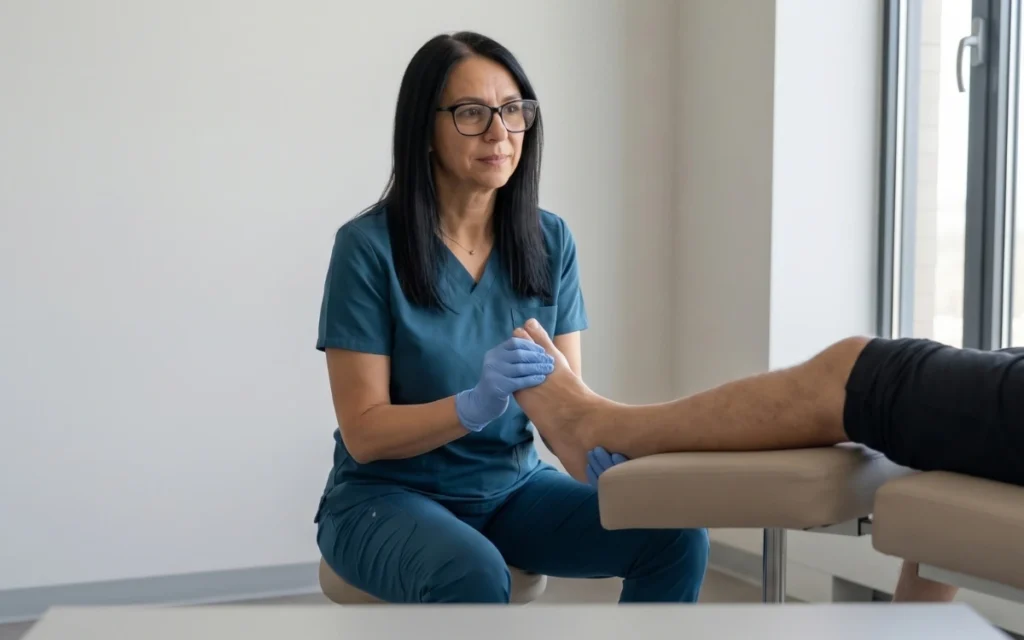
We start with a conversation and a look at your feet. Using specialist podiatry tools, we take off the thickened skin gradually. We also work on hard skin under the nail. Then we apply a care product. When needed, we pick an orthosis, a custom pad that takes pressure off the spot.
You leave knowing how to care for your feet
After the visit you get clear advice for home: which products to choose, how often to use them and which habits to avoid so the skin hardens more slowly. If you also want care for your whole feet and nails, see our podological pedicure.
Regular visits, with a plan
With calluses, we check pressure points and how the foot bears weight. We work on the thickened skin and discuss care between visits. Follow-up frequency depends on the skin’s condition.
If the cause lies in how you load your foot, we suggest a foot and gait assessment. That makes it easier to take pressure off the spot where the callus forms. This way our advice targets the cause, not only the thickened skin.
How much callus care costs
Prices are approximate. Your podologist confirms the final price after assessing your feet. If hard skin covers the whole foot, they may suggest foot care or a podological pedicure.
Your visit step by step
A calm conversation
A calm conversation
Foot assessment
Foot assessment
The procedure
The procedure
Advice and follow-up
Advice and follow-up
What our clients say
Calluses on feet: common questions
What is the difference between a callus and a corn?
A callus is a wide, flat area of thick skin that rarely hurts at one point. A corn is smaller, goes deeper and often has a hard core that stings when pressed. Both come from pressure. If the pain sits in one spot, see how we work on a corn with a core.
What causes calluses on feet?
Most often, pressure that keeps landing on the same spot. Tight shoes, high heels, long hours standing and the way you place your foot all play a part. It often affects people who stand a lot or train. To check how pressure spreads across your foot, book a foot assessment.
What is a callus under the toenail?
It is thickened skin under the free edge of the nail, also called a subungual callus. It often hurts under pressure, especially in closed shoes and on longer walks. We work on it as a separate procedure. The price is per toe, and you will find it in the price table on this page.
Can I file down calluses at home?
Yes, if you do it gently and regularly. Do not use razor blades, bladed graters or scissors, and do not cut thick skin yourself. Filing too hard irritates the skin. Short, frequent filing works better than rare, heavy sessions. We will suggest a file and a cream at your visit.
Is hyperkeratosis of the feet the same as calluses?
Almost. Hyperkeratosis is the professional term for excessive thickening of the outer skin. A callus is one common form of it, but hard skin can also form corns or a thick layer over the whole heel. At your visit we look at the skin on your feet and choose how to work on it.
How often should I have my calluses done?
Usually every few weeks. Skin renews itself in a cycle of about 28 days, so a visit roughly every 4 weeks suits many people. If your feet carry a heavy load, the gaps can be shorter. We will set the exact rhythm after your first visit, once we see how fast the skin builds up.