


Corns on your feet – we find out where they come from
Corn care, including corns with a core
A corn is a hard, painful spot where a shoe or bone presses on the skin. We help reduce that pressure, so the corn comes back less often.
Corn with a core on your foot
A corn on the foot, sometimes called a clavus, is thickened skin in a spot under constant pressure. A hard core forms in the middle, pushes deeper into the skin and hurts. We take care of corns at our practice in Mokotów.
Every step presses on the spot
A painful corn can appear on a toe, between the toes, under the foot or on the heel. Sometimes there’s a dot in the middle, and it keeps coming back to the same place. When you walk, it feels “like a stone in your shoe”. Calluses and hard skin look different: the thickening is wider.
We take care of the core too
First we pare down the thickened skin around the corn, then work on its core. To finish, we apply a care product. If the corn forms because a toe is under pressure, we suggest a custom orthosis to offload the toe or the pressure point.
You know what causes it
After the procedure we explain what is pressing on your skin and how to change that. We keep it simple, using your own shoes and the way you walk as examples. If the cause lies in how your foot takes the load, foot diagnostics and insoles can help.
We look at the whole foot, not just the corn
A corn is a sign of pressure, so the procedure is only half the job. We combine podiatry with orthopaedic podiatry and gait analysis to see how your foot works when you walk. Oksana Holovko, an orthopodology specialist, leads this part.
After the procedure you get clear advice and the option of follow-up visits, so the result lasts longer. We don’t rush: we book as much time as your visit needs and answer all your questions.
How much does corn care cost
These prices are a guide. The specialist sets the final amount after assessing your foot, as it depends on how deep the corns are and how many there are.
Your visit step by step
A calm conversation
A calm conversation
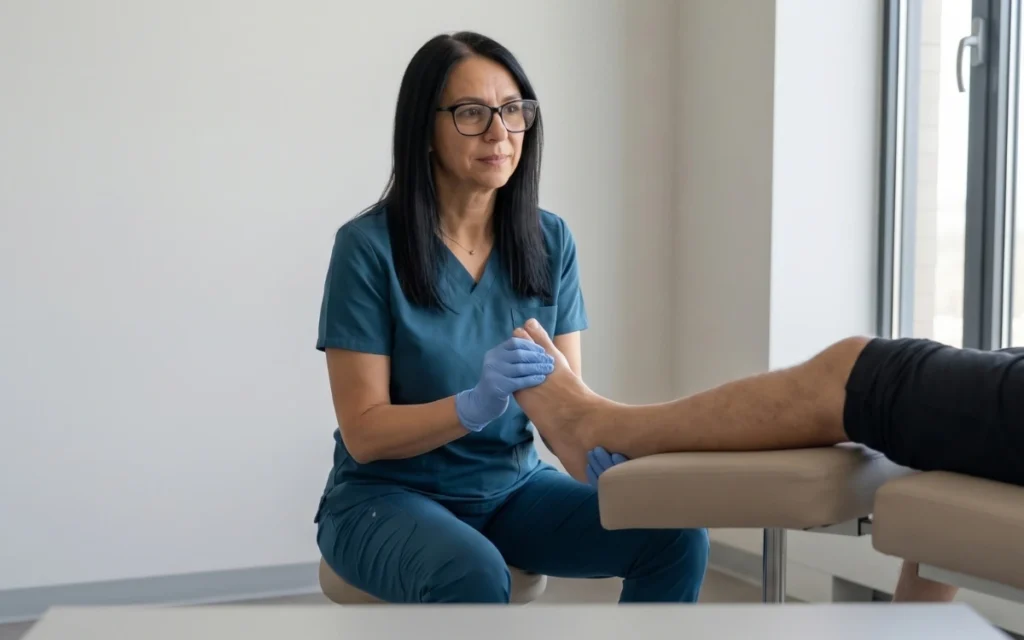
Foot assessment
Foot assessment
The procedure
The procedure
Advice and follow-up
Advice and follow-up
What our clients say

Corns on feet: common questions
What causes corns on feet?
Usually repeated pressure and friction in one spot. The skin protects itself by getting thicker. Tight or stiff shoes, a raised seam, the position of your toes and the way you load your foot when walking all play a part. That’s why we ask about your footwear and daily activity at the visit.
Will a corn with a core grow back after the procedure?
It can, if the pressure is still there. The procedure itself doesn’t change how your shoe or toe presses on the skin. That’s why, after the procedure, we look with you for ways to reduce that pressure. At the follow-up visit we check that the skin in that spot isn’t thickening again.
When should I see a podologist about a corn?
When the corn hurts as you walk, keeps coming back despite home remedies or sits deep. It’s also worth coming in if the skin under it darkens. Sometimes what looks like a corn turns out to be a plantar wart. If there’s redness, pus, swelling or fever, see your GP first.
Does corn care hurt?
In the majority of cases the procedure is well tolerated. We work gently and step by step, and you tell us how you feel throughout. You may feel mild discomfort where the skin is under heavy pressure. If needed, we use soothing products to make you more comfortable.
My corn has fluid in it. Can I pop it?
No. A corn with fluid is usually a friction blister, not a corn with a core. Don’t pierce it yourself; cover it with a plaster and reduce the pressure, for example by changing your shoes. If the blister doesn’t go away for a while or it hurts, come to the practice for an assessment.