

Plantar warts – podological care
Podological care for plantar warts
A plantar wart on the sole can hurt with every step. We help at our practice and show you how to avoid spreading the virus.
Plantar wart care at our Mokotów practice
A plantar wart is a viral wart on the sole of the foot. Body weight presses it into the skin, which is why it hurts when you walk. We assess the wart and carry out a podiatry procedure without a scalpel. Warts on feet are also common in children.
A hard spot that hurts
Warts on feet appear on the heel, under the foot, on a toe, next to the nails or between the toes. You may see black dots on the surface, and pressure is painful. New ones can appear nearby, as with mosaic warts. A wart can look like a corn, but it hurts differently.
Wart assessment and procedure
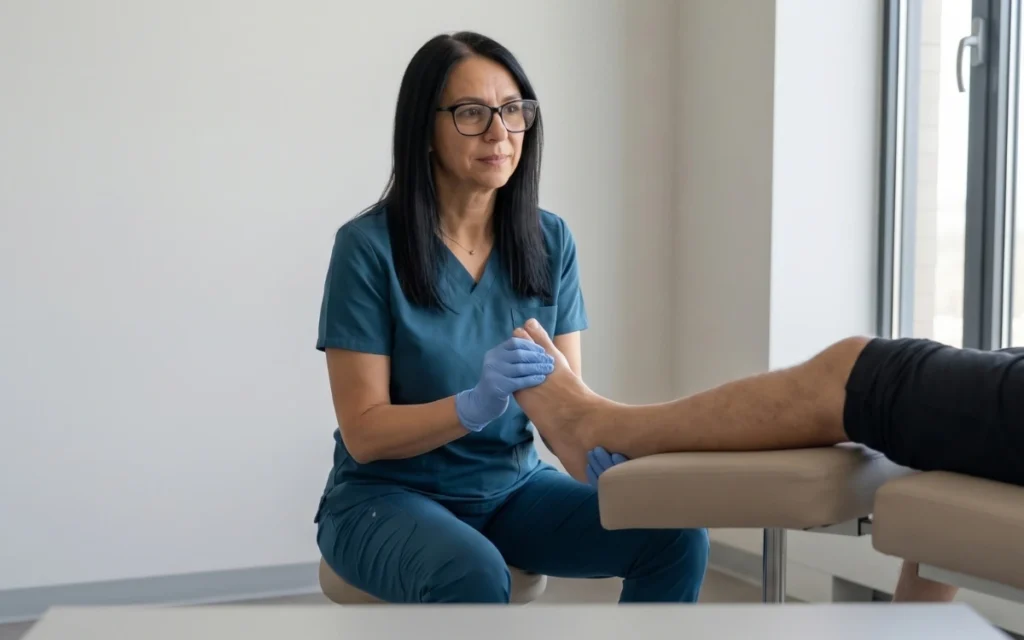
First we check that it really is a wart, because a corn on the foot needs a different approach. Then we carry out the procedure and protect the skin in that area at the end. If the wart needs another specialist, we’ll tell you who to see.
You know how to protect your feet
We explain what to do at home: your own towel and slippers, flip-flops at the pool, and no scratching or picking at the wart. This protects your other foot and the people you live with from the virus. We also tell you when to come back for a check-up.
No fear and no aggressive methods
That’s the principle of Oksana Holovko, founder of ORTHOPODO and a podologist since 2009. With plantar warts we work gently and step by step. You tell us how you feel as we go, so we can adjust the pace.
To be honest, a wart sometimes needs more than one visit. We agree a plan at your first appointment and adjust it after each visit. Every day we work with real cases of plantar warts at the practice, not just textbook ones.
How much does plantar wart care cost
The price depends on the size and number of warts. Prices are a guide; the specialist confirms the final price after assessing your feet.
Your visit step by step
A calm conversation
A calm conversation
Foot assessment
Foot assessment
The procedure
The procedure
Advice and follow-up
Advice and follow-up
What our clients say

Plantar warts: questions and answers
What causes plantar warts and are they contagious?
Warts are caused by the human papillomavirus (HPV), which is why warts on the feet are sometimes called papillomas. The virus spreads through contact, usually in damp shared places: at the pool, in the shower and in changing rooms. That’s why plantar warts are contagious.
How can I tell a wart from a corn?
A wart often breaks up the skin’s natural lines and hurts when squeezed from the sides. A corn usually hurts when pressed from above. These are only clues, because both can look alike. You’ll get a clear answer only after a specialist assesses it at your visit.
Does the wart procedure hurt?
In the majority of cases the procedure is well tolerated. You may feel mild discomfort in sensitive or heavily loaded spots, such as the heel or the area under the toes. If needed, we use soothing products, which make the procedure more comfortable for you.
How many visits does it take to get rid of a plantar wart?
It depends on the size, depth and number of warts. After the first procedure we see how the skin responds and tell you whether and when to come back. The number of visits can’t be predicted in advance, because every wart behaves differently. You’ll find guide prices in our price list.
Can I get rid of a wart at home?
We don’t recommend cutting, burning or scratching a wart yourself. It’s easy to damage the skin and spread the virus that way. If a home remedy hasn’t helped or the wart hurts when you walk, book a visit. We’ll assess it and tell you what we can do at the practice.
Can a wart come back after the procedure?
Yes. The virus can stay in the skin or reach it again from your surroundings. That’s why home-care advice and a follow-up visit matter so much after the procedure. At the follow-up we check the area and the skin around it, and if a new wart has appeared, we plan the next step.